No products in the cart.
How to Choose the Right Activewear for Every Workout
Whether you’re hitting the gym, going for a morning run, practicing yoga, or training outdoors, the right activewear can make

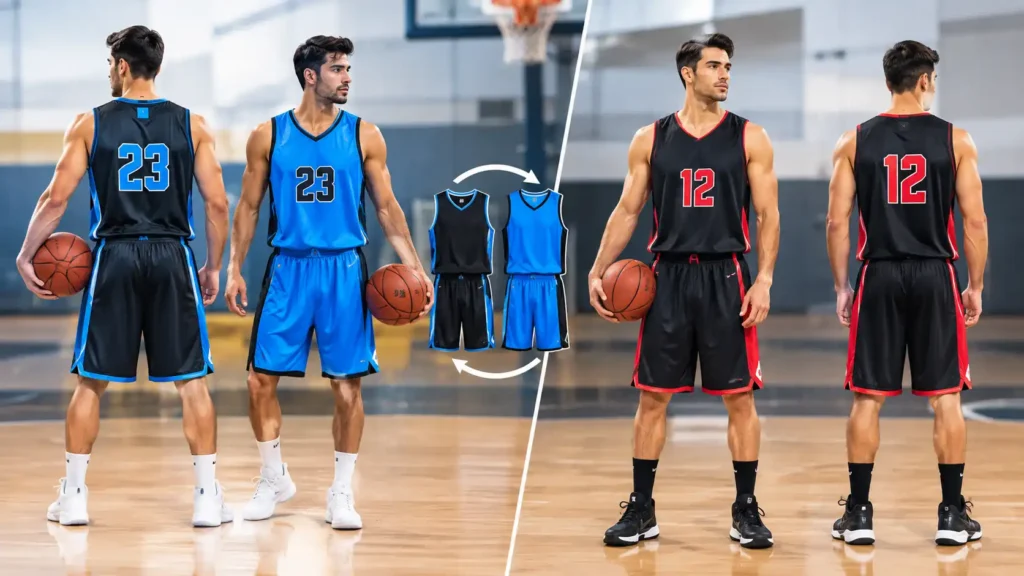
Every basketball program eventually hits the same fork in the road. Buy one reversible set that covers home and away, or buy two single-sided sets built for game day. The answer changes with your league level, budget, climate and how often your players actually wear the uniform.
We build both styles every week. Here is what we have learned about where each one wins, where it quietly fails, and how to decide without guessing.
A reversible jersey is two layers of mesh stitched together at the neck, armholes and hem. One side is usually light (white or a pale color) and the other side is dark. Each side carries its own number, so a player flips the jersey to switch from home to away.
A single-sided jersey is one layer of performance fabric. Teams that play under strict home/away color rules buy a light set and a dark set.
| Attribute | Reversible Uniform | Single-Sided Uniform (2 Sets) |
| Home and away coverage | One garment covers both | Two garments needed |
| Fabric layers | 2 | 1 |
| Breathability | Lower; heat builds in the double layer | Higher; single mesh vents faster |
| Moisture drying time | Slower | Faster |
| Design freedom | Limited on the reverse side | Full edge-to-edge sublimation |
| Number rules | Numbers on both faces must match | Standard |
| Best for | Practice, rec leagues, camps, youth | High school varsity, AAU, college, adult elite |
| Upfront cost per player | Lower than two full sets | Higher |
| Lifespan under heavy use | Shorter; both sides wear at once | Longer; wear is split across two sets |
That table gives you the general picture. The real decision sits in three places: rules, heat and cost per wear.
Before you fall in love with a reversible design, check your governing body. Under the current NFHS basketball uniform rules used by most U.S. high school associations:
A reversible jersey can satisfy all of that, but only if the light side is truly white and the dark side truly contrasts. Pale gold or light gray on the “dark” face will get flagged. If you want to sanity-check number sizes, our Jersey Size Charts guide covers how number height scales with jersey size.
Rec leagues, church leagues and most youth leagues rarely enforce these rules strictly. That is exactly why reversibles dominate there.
Here is the catch with reversibles. Two layers trap heat.
In a climate-controlled gym, most players will not notice during a 32-minute game. In a summer tournament gym in Texas, Arizona or Florida, where the air conditioning struggles and teams play three or four games a day, the difference is real. The second layer holds sweat, the jersey gets heavy by the second game, and it takes longer to dry between games.
Single-sided mesh vents faster, dries faster and feels lighter in the final minutes. For high-intensity programs, that matters more than saving money.
Practical rule: if your team plays outdoor summer ball or multi-game tournament weekends, lean single-sided. If you play one game a week indoors, a reversible holds up fine.
Single-sided uniforms give you full dye sublimation from shoulder to hem. Gradients, camo patterns, city skylines and tonal textures all print into the fibers with no weight added. You can browse our full custom basketball uniforms range to see how far a sublimated design can go.
Reversibles are more restricted:
If your brand identity leans on bold, busy graphics, a reversible will feel like a compromise.
Upfront price is the number most coaches compare. Cost per wear is the number that actually matters.
| Scenario | Reversible Set | Two Single-Sided Sets |
| Relative upfront cost per player | About 60 to 75 percent of two sets | 100 percent |
| Games and practices per season | 40 (both sides used) | 40 (split 20/20) |
| Expected seasons before replacement | 1 to 2 | 2 to 3 |
| Replacement trigger | Pilling and seam stress on both faces at once | One set wears first; the other stays usable |
| Best value when | Roster turns over yearly | Roster and branding stay stable |
Our take: youth and rec programs with high roster turnover win with reversibles because players age out before the jersey wears out. Varsity and club programs that keep the same colors for three or more seasons usually spend less per wear with two single-sided sets.
| Team Type | Recommended Build | Why |
| Youth rec league (ages 6 to 12) | Reversible | One purchase, fast turnover, no strict color rules |
| Middle school | Reversible or single-sided | Depends on state association enforcement |
| High school varsity | Single-sided (2 sets) | NFHS home white/away dark enforcement, longer use |
| AAU and club travel | Single-sided | Tournament heat, multi-game days, brand visibility |
| Adult rec and corporate leagues | Reversible | Cost control, casual play |
| Camps and clinics | Reversible | Split into scrimmage teams instantly |
| Practice squads | Reversible practice jerseys | Quick team switching during drills |
If you coach younger players, our Youth Basketball Team Uniforms ordering guide walks through sizing and roster collection step by step.
The rec league director. A director running 14 teams of 10-year-olds needed jerseys for 150 kids on a tight budget. Reversibles let every team scrimmage any other team without a second set. The league saved roughly a third compared with buying two sets per child.
The varsity coach. A high school coach wanted a sublimated gradient design that matched the school’s new gym floor. A reversible could not carry the gradient cleanly on both sides. Two single-sided sets delivered the look and met the home white/away dark rule.
The AAU program. A travel program playing 30 plus tournament games each summer switched from reversibles to single-sided after players complained about heavy, soaked jerseys by game three. Players pair these with custom warm-up jackets and shooting shirts between games, which keeps the game jersey dry until tip-off.
Answer these five questions. Three or more “yes” answers point to single-sided.
Zero to two “yes” answers? A reversible is probably the smarter buy.
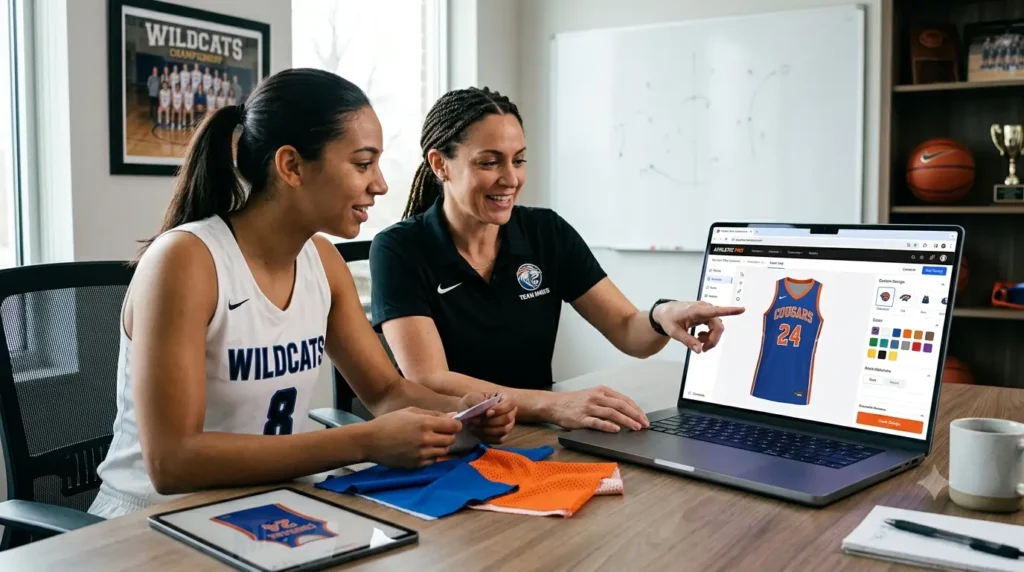
Whichever build you choose, the order process is the same. Send us your colors, logo, roster names and numbers, and size breakdown. We return a digital mockup for approval before anything goes to production.
Ready to see your design? Request a custom uniform quote and tell us your league, roster size and deadline. Want to compare our other sports first? Browse the full shop.
Yes, if the light side is white and the dark side clearly contrasts with white, and numbers meet NFHS size and color rules. Check with your state association, since some prefer dedicated home and away sets.
Yes. Two layers of mesh hold more heat and sweat than one. Most players notice it most during summer tournaments or in poorly ventilated gyms.
Yes. Each layer is sublimated before the jersey is sewn. Dense graphics on one side can sometimes ghost through a lighter side, so we recommend simpler reverse-side designs.
Two single-sided sets usually last longer, because wear is split across two garments. A reversible gets worn every game, so both faces age at the same rate.
Reversibles win on price and convenience for youth, rec and practice use. Single-sided uniforms win on comfort, design freedom and long-term value for serious competitive programs. Match the build to your league rules and your schedule, not just the invoice total, and your players will feel the difference by the fourth quarter.
Whether you’re hitting the gym, going for a morning run, practicing yoga, or training outdoors, the right activewear can make
Athletes sometimes face severe overheating and restricted mobility during intense tournament games because of heavy, non-breathable athletic clothing. Selecting court
Ballplayers frequently experience severe fabric friction and restricted shoulder rotation because of poorly tailored workout clothing. Selecting team uniforms requires