No products in the cart.

How to Choose the Right Activewear for Every Workout
Whether you’re hitting the gym, going for a morning run, practicing yoga, or training outdoors, the right activewear can make


GSM stands for grams per square metre. It is the weight of one square metre of a fabric, and it is the single most useful number on a jersey specification. GSM predicts opacity, durability, drape and heat retention. It does not by itself predict wicking, which is a separate property built from fibre chemistry and knit structure. This guide explains both, gives weight ranges by sport, and shows what changes when you move a jersey 20 GSM in either direction.
A 150 GSM jersey fabric weighs 150 grams per square metre. A typical adult jersey uses roughly 0.7 to 0.9 square metres of cloth, so the fabric in that garment weighs around 105 to 135 grams. Two fabrics at the same GSM can still feel different, because weight says nothing about how the yarn is knitted or how thick each filament is. GSM sets the envelope, and knit structure fills it.
| GSM Range | Feel | Typical Use | Trade-Off |
| 110 to 130 | Very light, semi-sheer | Running singlets, warm-climate training | Show-through, short lifespan |
| 130 to 145 | Light | Youth rec jerseys, short seasons | Wears through in one heavy season |
| 145 to 165 | Standard | Most team sports, most levels | Best balance for the majority of teams |
| 165 to 185 | Substantial | Contact sports, long seasons | Warmer in high heat |
| 185 to 210 | Heavy | Baseball, outerwear, warmups | Noticeably hot in summer play |
Polyester is hydrophobic, meaning the fibre itself does not absorb water. That is the starting point, not the mechanism. Wicking happens because the yarn is engineered with capillary channels that draw liquid along the fibre surface and spread it across a wide area, where it evaporates faster. Three factors control performance.
Cotton does the opposite. It absorbs up to 25 times its weight in water, holds it, and gets heavier as a match progresses. That is why no serious team jersey uses cotton, and why sublimated polyester dominates the category. Fibre and construction characteristics for each base cloth are listed on our fabric types page.
| Knit | Typical GSM | Airflow | Opacity | Best Use |
| Single jersey knit | 130 to 155 | Moderate | Moderate | Lightweight game shirts |
| Interlock | 150 to 185 | Lower | High | Main body panels, printed graphics |
| Micro mesh | 130 to 160 | High | Lower | Side panels, back yokes |
| Birdseye | 140 to 170 | High | Moderate | Full-body warm-climate jerseys |
| Poly spandex knit | 150 to 190 | Moderate | High | Fitted cuts needing stretch recovery |
Strong jerseys mix knits. A common build uses interlock across the chest for print quality and micro mesh at the sides and upper back for airflow, which delivers opacity where the graphics are and ventilation where sweat concentrates.
| Sport and Level | Recommended GSM | Reason |
| Basketball, indoor | 140 to 165 | Continuous motion in heated gyms |
| Volleyball, indoor | 150 to 165 | Opacity plus floor-contact abrasion |
| Soccer, outdoor | 140 to 165 | Wide temperature range across a season |
| Football, contact | 165 to 190 | Grab load at shoulder and side seams |
| Baseball and softball | 170 to 200 | Sliding abrasion on dirt infields |
| Practice and reversible sets | 135 to 155 | Lower duty cycle, cost-sensitive |
| Warmups and outerwear | 200 to 280 | Insulation rather than performance |
Compare finished specifications across our product categories, including the fitted cuts in our volleyball jerseys range and the reinforced construction in our football jerseys category.
| Change | Effect on Opacity | Effect on Heat | Effect on Lifespan | Effect on Cost |
| Down 20 GSM | Show-through risk rises | Cooler by a noticeable margin | Roughly one season shorter | $3 to $6 lower |
| Up 20 GSM | Fully opaque, better print field | Warmer in high heat | Roughly one season longer | $3 to $6 higher |
The practical rule is simple. Season length and contact level set the floor, and playing temperature sets the ceiling. A youth team playing 12 indoor games should not buy 190 GSM, and a travel baseball programme playing 60 games should not buy 140 GSM.
| Playing Condition | Recommended GSM | Construction Response |
| Heated indoor gym, winter | 150 to 165 | Mesh side panels, wicking inner face |
| Outdoor above 85F | 135 to 155 | Birdseye or mesh body, light colours |
| Outdoor below 45F | 155 to 175 | Sized for a base layer underneath |
| High-humidity summer | 140 to 160 | Maximum open-knit area, no film prints |
| Dirt and turf contact | 170 to 200 | Interlock body, flatlock seams |
| Tournament format, multiple matches daily | 145 to 165 | Two jerseys per player for drying |

A complete jersey fabric specification carries five numbers, not one. Suppliers that quote only GSM are giving you a fifth of the picture.
| Specification | Typical Team Jersey Value | What It Controls |
| GSM | 145 to 165 | Opacity, durability, heat retention |
| Composition | 88 to 92 percent polyester, 8 to 12 percent elastane | Stretch and recovery |
| Knit structure | Interlock, mesh, birdseye | Airflow and print surface |
| Filament type | Micro-denier, grooved or multi-lobal | Wicking rate |
| Finish | Hydrophilic inner face | Moisture transfer off skin |
Ask for all five in writing when comparing quotes. Two jerseys quoted at 155 GSM can differ by a full season of usable life once composition and filament type are known.
Sublimated graphics tolerate this regime better than any surface print, because the ink sits inside the fibre rather than on top of it. That difference is set out in our comparison of stitched vs sublimation, and method mechanics are covered on our printing methods page.
| Scenario, 15-Player Roster | Season 1 | Season 2 | Season 3 | Three-Season Total |
| Under-specified at 130 GSM | $285 | $285 full replacement | $285 full replacement | $855 |
| Correctly specified at 155 GSM | $345 | $0 | $46, two replacements | $391 |
| Over-specified at 195 GSM | $450 | $0 | $0 | $450 |
Under-specifying is the expensive mistake. Over-specifying costs a modest premium and buys comfort problems in summer play rather than budget problems.
No. Above roughly 185 GSM a game jersey becomes hot without becoming more durable in any way that matters indoors. Weight is a specification, not a quality grade.
Opacity falls with weight. Below about 140 GSM in a pale colour, saturation becomes visible. Move up 15 to 20 GSM or place a mid-tone panel across the torso.
They do when fabric softener has been used, or after the finish degrades through repeated hot washing. Correct laundering preserves performance for the life of the garment.
Ask for it in writing before ordering, and order a single sample garment to confirm. Measured sizing sits on our size chart, and specification questions can be raised directly.
Set GSM from season length and contact level first, then check it against playing temperature, then choose a knit that puts opacity where the graphics are and airflow where the sweat is. Most teams land correctly between 145 and 165 GSM. Browse finished specifications in our shop or read further specification guides on our blog, then tell us your sport, season length and venue through the contact page and we will recommend a weight and knit combination with the reasoning attached.
Whether you’re hitting the gym, going for a morning run, practicing yoga, or training outdoors, the right activewear can make
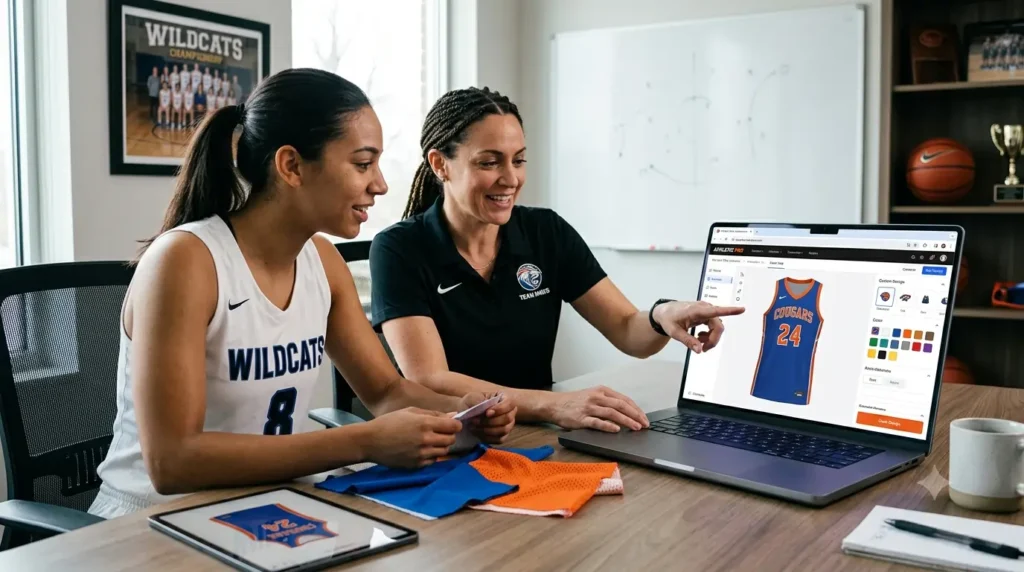
Athletes sometimes face severe overheating and restricted mobility during intense tournament games because of heavy, non-breathable athletic clothing. Selecting court

Ballplayers frequently experience severe fabric friction and restricted shoulder rotation because of poorly tailored workout clothing. Selecting team uniforms requires